
Salary In-Hand Calculator India
Use this Salary In-Hand Calculator India to calculate your monthly take-home salary after PF, professional tax, income tax and other deductions. This free calculator is designed as per Indian salary structure and latest tax rules.| CTC | |
|---|---|
| Total Deductions | |
| In-Hand Salary |
What is Salary In-Hand?
Salary In-Hand Calculator India, also known as take-home salary, is the actual amount that an employee receives in their bank account every month after all mandatory and optional deductions are applied. In India, many employees confuse their Cost to Company (CTC) with in-hand salary, which often leads to unrealistic expectations and financial misplanning.
Your salary in-hand is calculated after deducting components such as Provident Fund (PF), income tax, professional tax, employee insurance, gratuity contribution and other company-specific deductions. The remaining amount after these deductions is what you receive as net salary.
A Salary In-Hand Calculator India removes confusion by showing the exact monthly amount you will actually receive instead of displaying inflated CTC figures.
CTC vs Gross Salary vs In-Hand Salary
Understanding the difference between CTC, gross salary and in-hand salary is crucial for every salaried employee in India.
CTC (Cost to Company) is the total amount a company spends on an employee annually. It includes direct salary components as well as indirect benefits such as employer PF contribution, gratuity, insurance, bonuses and other perks.
Gross Salary is the salary earned by an employee before deductions. It includes basic pay, HRA, allowances, bonuses and incentives, but excludes employer-side benefits like gratuity.
In-Hand Salary is the final amount credited to the employee’s bank account after deducting PF, income tax, professional tax and other recoveries.
Many job offers advertise a high CTC, but the actual in-hand salary may be significantly lower. This is why using a salary in-hand calculator before accepting an offer is extremely important.
Typical Salary Structure in India
Most Indian companies follow a structured salary breakup. While exact components may vary by employer, the following elements are commonly included:
- Basic Salary: Usually 40–50% of CTC; forms the base of all calculations
- House Rent Allowance (HRA): Paid to employees living in rented accommodation
- Special Allowance: Balancing figure used by companies
- Conveyance Allowance: For commuting expenses
- Medical Allowance: For healthcare expenses
- Bonus / Incentives: Performance-linked pay
The salary structure directly affects tax liability and in-hand salary. A well-designed structure can legally reduce taxes and increase take-home pay. This is where a salary in-hand calculator becomes useful for comparison and planning.
Common Salary Deductions in India
Salary deductions are mandatory or optional amounts subtracted from gross salary before calculating in-hand pay. The most common deductions include:
- Provident Fund (PF): 12% of basic salary (employee share)
- Income Tax: Based on tax slab, regime and deductions
- Professional Tax: Levied by state governments
- Employee Insurance: Health or life insurance premiums
- Other Recoveries: Loan EMIs, advance recovery, meal cards
These deductions vary based on salary level, state of employment and company policies. A reliable salary in-hand calculator considers all major deductions to provide an accurate estimate.
You can also explore dedicated calculators for specific loan types:- Home Loan EMI Calculator
- Personal Loan EMI Calculator
- Car Loan EMI Calculator
- Education Loan EMI Calculator
Provident Fund (PF) and Its Impact on Salary In-Hand
Provident Fund (PF) is one of the most significant deductions that directly affects salary in-hand for salaried employees in India. Under the Employees’ Provident Funds and Miscellaneous Provisions Act, eligible employees are required to contribute 12% of basic salary towards PF every month.
In addition to the employee contribution, the employer also contributes an equal amount. However, the employer’s contribution is already included in the Cost to Company (CTC) and does not form part of your in-hand salary.
For example, if your basic salary is ₹30,000 per month, your PF deduction will be ₹3,600. This amount is subtracted from your gross salary before calculating your take-home pay.
A Salary In-Hand Calculator India clearly shows PF deduction so employees can understand why their in-hand salary is lower than expected. While PF reduces monthly cash flow, it acts as a long-term retirement saving instrument.
Income Tax Deduction and Tax Regimes Explained
Income tax is another major component that impacts salary in-hand in India. The amount of tax deducted depends on your annual income, applicable tax slabs, exemptions and the tax regime you choose.
Currently, salaried employees in India can choose between the Old Tax Regime and the New Tax Regime. Each regime has different slab rates and deduction benefits.
Under the old tax regime, employees can reduce taxable income using deductions such as Section 80C, Section 80D, HRA exemption and standard deduction. Under the new tax regime, tax rates are lower but most exemptions and deductions are not allowed.
A salary in-hand calculator helps compare both regimes and shows which option results in higher take-home salary. This comparison is crucial because choosing the wrong regime can reduce your net income significantly.
Professional Tax and State-Wise Variations
Professional tax is a state-level tax imposed on salaried employees in India. It is deducted monthly by the employer and deposited with the state government.
The amount of professional tax varies from state to state. In most states, it ranges between ₹150 to ₹250 per month. Some states deduct professional tax only in specific months.
Although the amount may appear small, it still reduces monthly salary in-hand. A salary in-hand calculator includes professional tax based on standard assumptions to provide a realistic estimate.
Allowances and Their Effect on Take-Home Salary
Allowances form a significant part of salary structure and can influence tax liability and in-hand salary. Common allowances include HRA, conveyance allowance, medical allowance and special allowance.
House Rent Allowance (HRA) is partially tax-exempt if the employee lives in rented accommodation. The exemption depends on salary, rent paid and city of residence.
Conveyance and medical allowances were earlier tax-exempt but are now included within the standard deduction. Special allowance is fully taxable and directly impacts take-home salary.
A well-structured salary can increase in-hand pay without increasing CTC. A salary in-hand calculator helps employees understand how allowances affect monthly income.
Real Salary In-Hand Calculation Example
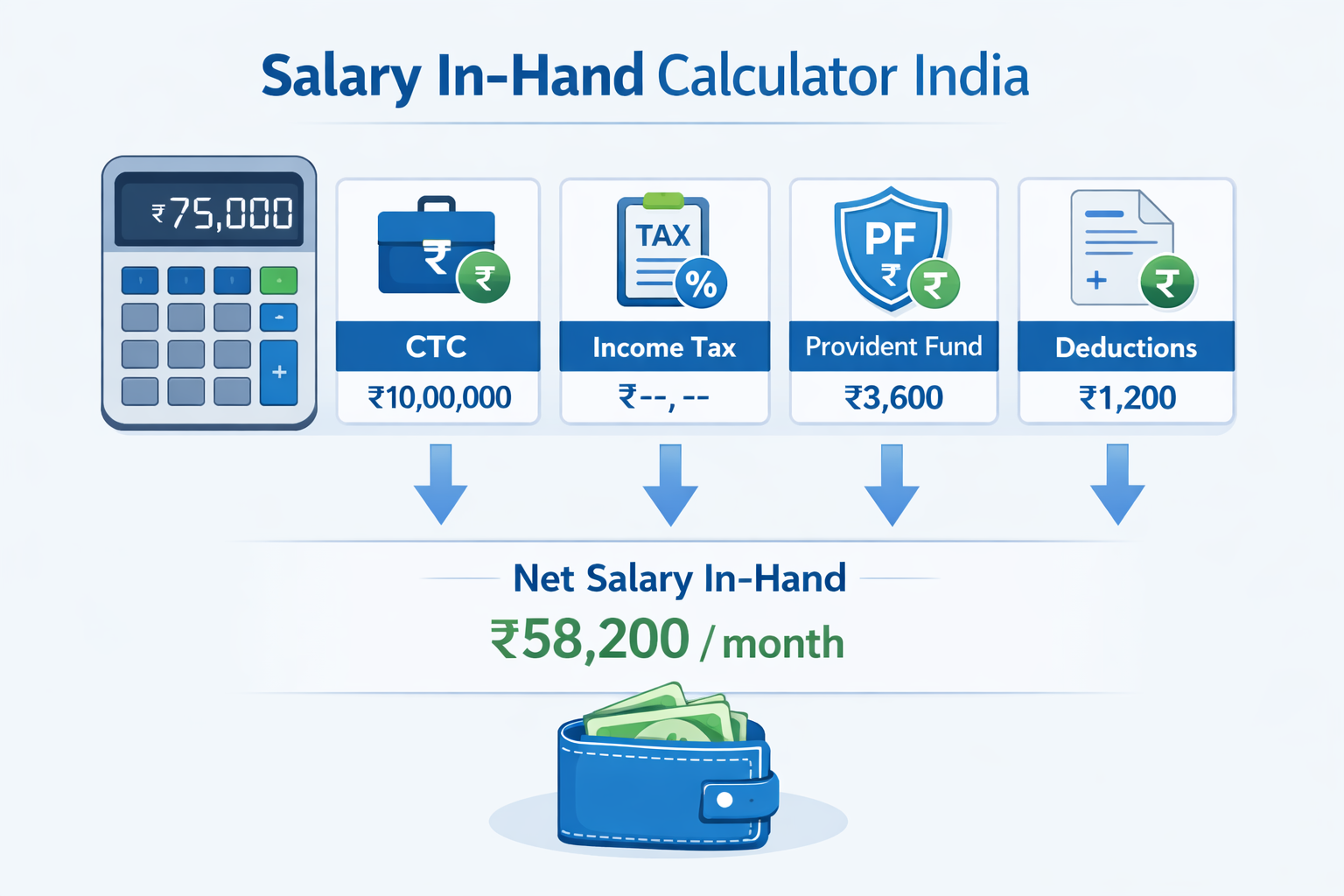
Let us understand salary in-hand calculation with a simple example. Suppose an employee has an annual CTC of ₹10,00,000.
After breaking down CTC into basic salary, HRA, allowances and employer PF, the gross monthly salary may come to around ₹75,000.
From this gross salary, deductions such as employee PF (₹3,600), professional tax (₹200) and income tax (as per slab) are applied.
After all deductions, the final in-hand salary may reduce to around ₹55,000–₹58,000 per month, depending on tax regime and exemptions claimed.
This example clearly shows why relying only on CTC figures can be misleading. A salary in-hand calculator provides this clarity instantly.
Why Use a Salary In-Hand Calculator India?
Calculating salary in-hand manually is complex and prone to errors. Tax rules change frequently, and salary structures differ across companies.
Using a salary in-hand calculator ensures accuracy, saves time and provides instant results. It helps employees plan monthly budgets, savings and investments effectively.
Whether you are negotiating a job offer, switching companies or planning finances, a salary in-hand calculator acts as a reliable decision-making tool.
In the next section, we will cover salary negotiation tips, tax-saving strategies, FAQs and final takeaways to complete this comprehensive guide.
How Salary In-Hand Calculator Helps in Salary Negotiation
One of the most practical uses of a Salary In-Hand Calculator India is during job offer evaluation and salary negotiation. Many companies highlight Cost to Company (CTC) in offer letters, which can be misleading for candidates.
Two job offers with the same CTC can result in very different in-hand salaries depending on salary structure, deductions and tax components. By calculating take-home salary beforehand, employees can negotiate better compensation terms.
For example, negotiating a higher basic salary or better allowance structure can significantly increase in-hand pay without increasing total CTC. A salary in-hand calculator gives you data-backed confidence during negotiations.
Tax-Saving Strategies to Increase Salary In-Hand
Smart tax planning plays a crucial role in improving salary in-hand. Under the old tax regime, employees can legally reduce taxable income using deductions and exemptions.
Common tax-saving options include investments under Section 80C, health insurance premium under Section 80D, and home loan interest under Section 24(b). These deductions reduce tax liability and increase take-home salary.
A salary in-hand calculator helps simulate different tax-saving scenarios and shows how deductions impact net salary. This allows employees to plan investments efficiently.
CTC vs Gross Salary vs In-Hand Salary
Understanding the difference between CTC, gross salary and in-hand salary is essential for every salaried professional in India.
CTC includes employer PF contribution, bonuses, gratuity and other benefits that may not be received monthly. Gross salary is the amount before deductions. In-hand salary is what you actually receive in your bank account.
A salary in-hand calculator clearly breaks down these components and removes confusion, especially for freshers and first-time job switchers.
Using Salary In-Hand for Monthly Budget Planning
Budgeting should always be based on in-hand salary, not CTC. Monthly expenses, savings, EMIs and investments should be planned according to actual take-home income.
A salary in-hand calculator allows individuals to plan rent, groceries, transport, insurance and investments realistically without overestimating income.
This is especially important for people with loan EMIs, as incorrect salary assumptions can lead to financial stress and cash flow issues.
Salary In-Hand Calculator for Job Switchers
When switching jobs, employees often focus only on percentage hike in CTC. However, a higher CTC does not always guarantee higher take-home salary.
Differences in PF structure, bonus payout frequency and tax regime can result in lower monthly in-hand despite higher CTC.
Using a salary in-hand calculator before accepting an offer ensures you make an informed decision and avoid unpleasant surprises after joining.
Salary In-Hand Calculator for Freshers
Freshers often struggle to understand salary slips and deductions. A salary in-hand calculator simplifies this learning process by providing a clear breakdown of salary components.
It helps new employees understand PF, tax deductions, professional tax and allowances from day one, improving financial awareness early in their careers.
Private vs Government Salary In-Hand Comparison
Salary structures in government and private sector jobs differ significantly. Government salaries have structured pay scales and fewer variable components, while private sector salaries are more flexible.
A salary in-hand calculator can be used for both sectors to estimate take-home salary accurately and compare compensation across job types.
Common Mistakes People Make While Calculating Salary
- Assuming CTC equals in-hand salary
- Ignoring PF and tax deductions
- Not comparing tax regimes
- Overlooking professional tax
- Planning expenses based on gross salary
A reliable salary in-hand calculator helps avoid these mistakes and promotes better financial discipline.
Is Salary In-Hand Calculator Accurate?
This salary in-hand calculator India uses standard assumptions followed by Indian companies and tax laws. While actual salary slips may vary slightly due to company-specific policies, the calculator provides highly accurate estimates for planning.
It is ideal for comparison, budgeting and salary evaluation purposes.
Frequently Asked Questions (FAQs)
- What is salary in-hand?
Salary in-hand is the net salary credited to your bank account after all deductions. - Is PF deducted from in-hand salary?
Yes, employee PF contribution is deducted monthly. - Does CTC include employer PF?
Yes, employer PF contribution is part of CTC. - Can I reduce tax to increase in-hand salary?
Yes, through tax-saving investments and exemptions. - Is this calculator free?
Yes, it is completely free to use. - Does it work for all companies?
Yes, it follows standard Indian salary rules. - Can freshers use this calculator?
Absolutely, it is ideal for freshers. - Is professional tax included?
Yes, standard professional tax assumptions are included.
Final Conclusion: Salary In-Hand Calculator India
A Salary In-Hand Calculator India is an essential financial tool for every salaried individual. It bridges the gap between CTC and actual take-home salary, enabling smarter decisions.
Whether you are negotiating a job offer, switching companies, planning taxes or managing monthly expenses, this calculator provides clarity, accuracy and confidence.
Always plan finances based on in-hand salary—not assumptions. Smart salary planning today leads to long-term financial stability.
For official loan and interest rate guidelines, refer to the Reserve Bank of India (RBI). You can also learn more about loan concepts from Investopedia.